Laboratory documentation you can verify
Every product we supply is backed by a branded Certificate of Analysis for its specific batch. Our certificates record the analytical specification and results — including purity by HPLC — so you can confirm exactly what you have received. Use the tools below to view current certificates, verify a batch, and access supporting documentation. All products are supplied for research use only.
Batch Verification
Search by product name or batch number to view the corresponding certificate.
Certificate Verification
Confirm the laboratory documentation for your product. Search by batch number (printed on your certificate) or by product name to view the corresponding branded MyPep Biotech Certificate of Analysis.
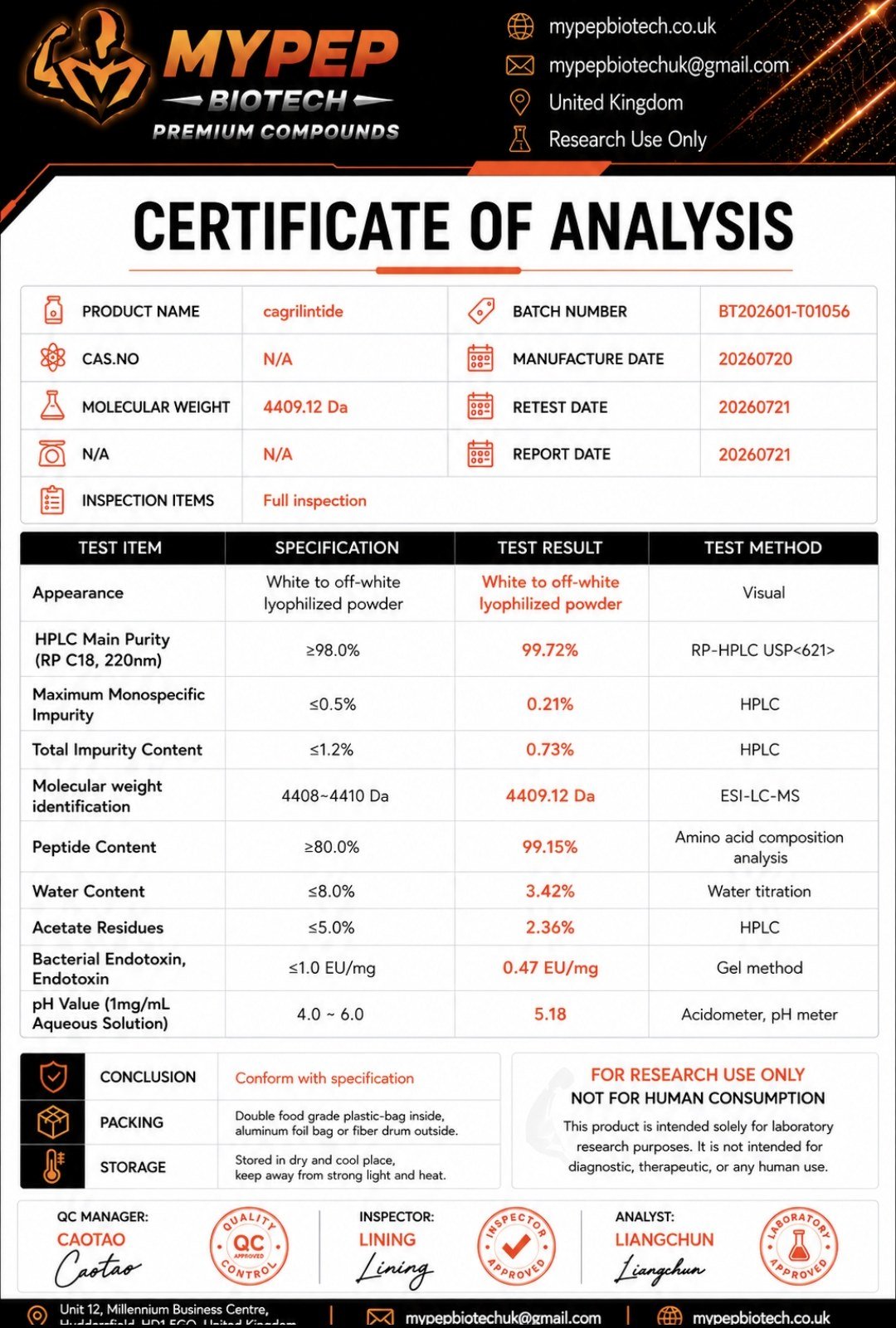
Cagrilintide
| Batch Number | BT202601-T01056 |
|---|---|
| Purity | 99.72% |
| Manufacture Date | 20 Jul 2026 |
| Status | Current |
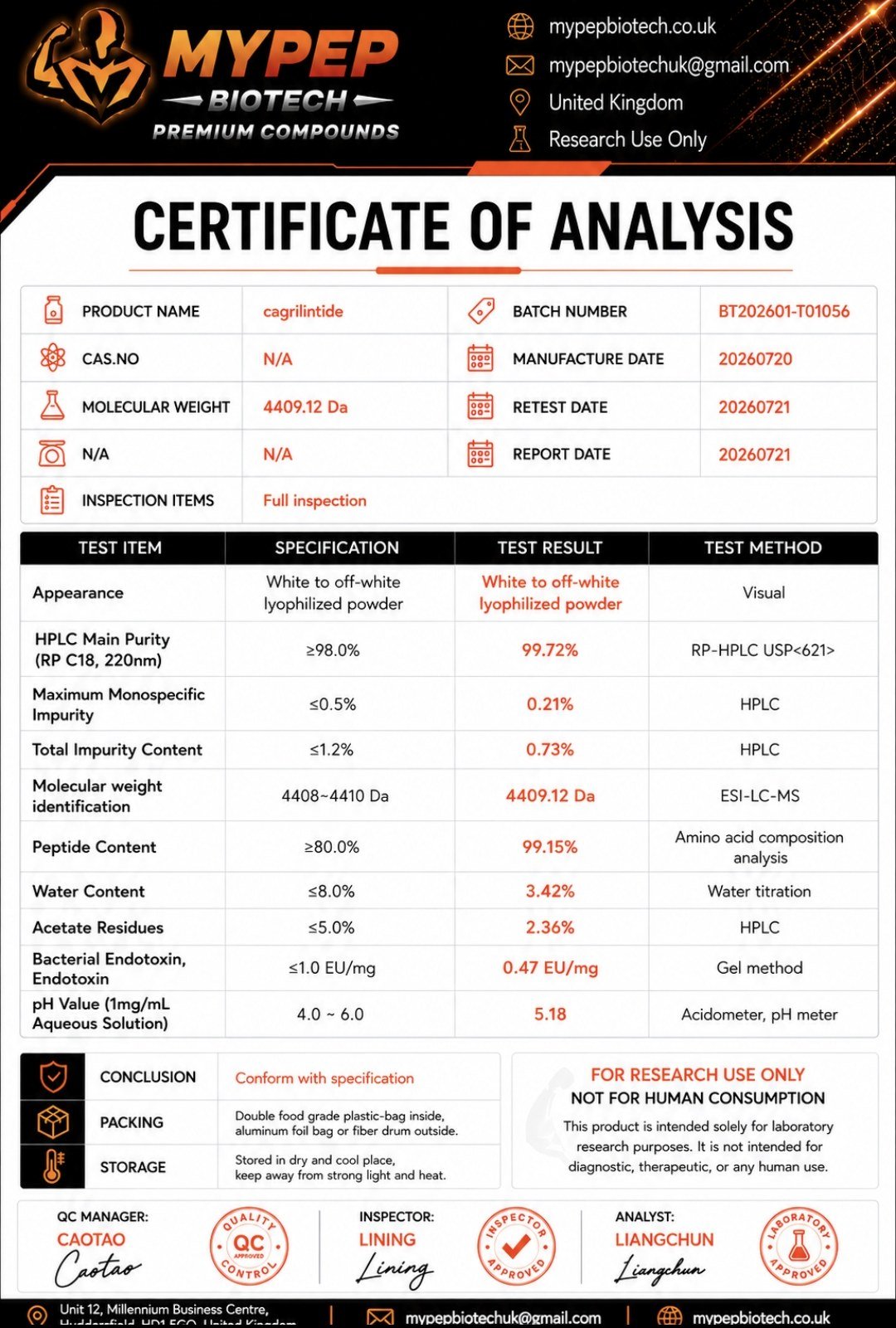
Cagrilintide
| Batch Number | BT202601-T01056 |
|---|---|
| Purity | 99.72% |
| Manufacture Date | 20 Jul 2026 |
| Status | Archived |
Research Use Only. All certificates are provided to support product identification and quality information for laboratory research purposes. Not for diagnostic, therapeutic, or human use.
Current Certificates
The current branded Certificate of Analysis for each product. Tap any certificate to view it full size.
Original Supplier Certificates
Our branded Certificates of Analysis are the primary documentation for every product. Where an original manufacturer certificate is available for a batch, it is offered as a secondary download on that product and here. Original supplier certificates can be requested for specific batches.
Frequently Asked Questions
What is a Certificate of Analysis (COA)?
A Certificate of Analysis is a laboratory document that records the analytical results for a specific manufactured batch — for example appearance, identity, purity by HPLC, and related tests. It supports product identification and quality information for research purposes.
Are these products for human use?
No. All products and their documentation are provided strictly for laboratory research use only. They are not intended for diagnostic, therapeutic, or any human or veterinary use.
Where do I find my batch number?
The batch number is printed on the product label and shown on the Certificate of Analysis. You can enter it in the Batch Verification search on this page to view the matching certificate.
What does the branded certificate contain?
Each branded MyPep Biotech certificate lists the product, batch number, manufacture and expiry dates, and the analytical specification and results for that batch, including purity determined by HPLC.
Can I see the original supplier certificate?
Where an original manufacturer certificate is available, it is offered as a secondary “Original Supplier Certificate” download alongside the branded MyPep certificate. The branded certificate is always shown first.
How current is the certificate shown?
Each product displays its current batch certificate. When a new batch is released, its certificate becomes current and the previous one is archived on record.

MyPep Biotech quality assurance process
MyPep Biotech uses a documented quality assurance process to support the traceability of research materials supplied through our UK website. Quality assurance is not a single test or claim. It is a series of checks covering supplier documentation, batch identification, analytical records, storage information and the connection between a product label and its supporting Certificate of Analysis (COA).
All MyPep Biotech materials are supplied strictly for laboratory and research use only. They are not medicines, foods, cosmetics or products for human or veterinary administration. The information on this page explains our documentation and quality controls; it does not provide medical advice or guarantee suitability for a particular experiment.
Batch identification and traceability
Batch traceability allows a researcher to connect a supplied material with the records held for that specific lot. Product labels and supporting documents should carry a consistent batch or lot reference. This helps prevent a certificate from one batch being used to represent another and gives our team a clear reference when responding to documentation queries.
- Product and compound name are checked against the relevant listing.
- A batch or lot reference is retained for document matching.
- Analytical reports are associated with the relevant batch where supplied.
- Customer documentation queries are handled using the batch reference.
- Records are reviewed if a label, certificate or report appears inconsistent.
Analytical documentation and HPLC
High-performance liquid chromatography (HPLC) is commonly used to assess chromatographic purity by separating detected components within a sample. The reported percentage relates to the principal chromatographic peak under the stated test conditions. It does not, by itself, establish identity, sterility, biological activity, safety or suitability for human use.
A responsible review considers the analytical method, report reference, batch number, test date and any limitations stated by the laboratory. Researchers can independently check the scope and status of UK laboratory accreditation using the UKAS organisation search. Accreditation should be assessed against the specific method and activity stated, rather than assumed from a laboratory name alone.
Different research protocols may require additional evidence, such as identity confirmation, mass analysis, water content, residual solvent testing or microbiological assessment. Researchers should determine which evidence is appropriate for their own protocol.
You can use our certificate verification tool to check whether a COA reference matches a record held by MyPep Biotech. Verification confirms a matching record; it is not independent regulatory approval.
Packaging, storage and handling information
Packaging and storage information helps preserve traceability and reduce avoidable handling problems. On receipt, researchers should inspect the outer packaging and label, confirm that the ordered material and batch reference are correct, and review any storage information supplied with the product. Materials should remain clearly labelled and be handled only by appropriately trained laboratory personnel using a suitable protocol and risk assessment.
If packaging is damaged, a label is unclear or the batch reference does not match the supporting document, isolate the item from active research work and contact us before proceeding. Include the order reference, product name, batch number and clear photographs where possible.
What quality assurance does—and does not—mean
Quality assurance provides a structured way to manage records, traceability and documented checks. It cannot remove every source of experimental uncertainty. Analytical results apply to the sample and batch tested under the conditions described in the report. Results should not be extended to another batch or used to support claims that the report did not test.
MyPep Biotech does not present research materials as approved treatments and does not make therapeutic or clinical claims. Our catalogue information is designed to help qualified researchers identify materials and supporting documentation. Visit the research catalogue, read our educational guides, or use the contact page for a batch-document query.
Quality assurance FAQs
Does every batch need its own supporting record?
Batch-specific records are important because analytical findings relate to the batch tested. Researchers should check that the reference on the supplied material matches the supporting document.
What should I do if information does not match?
Do not rely on the document until the discrepancy has been reviewed. Contact us with the batch reference and supporting images so that the relevant record can be checked.
Can quality assurance confirm clinical safety?
No. These controls relate to research documentation and traceability. MyPep Biotech materials are not supplied for human or veterinary use, and nothing on this page should be interpreted as clinical or medical guidance.