Description
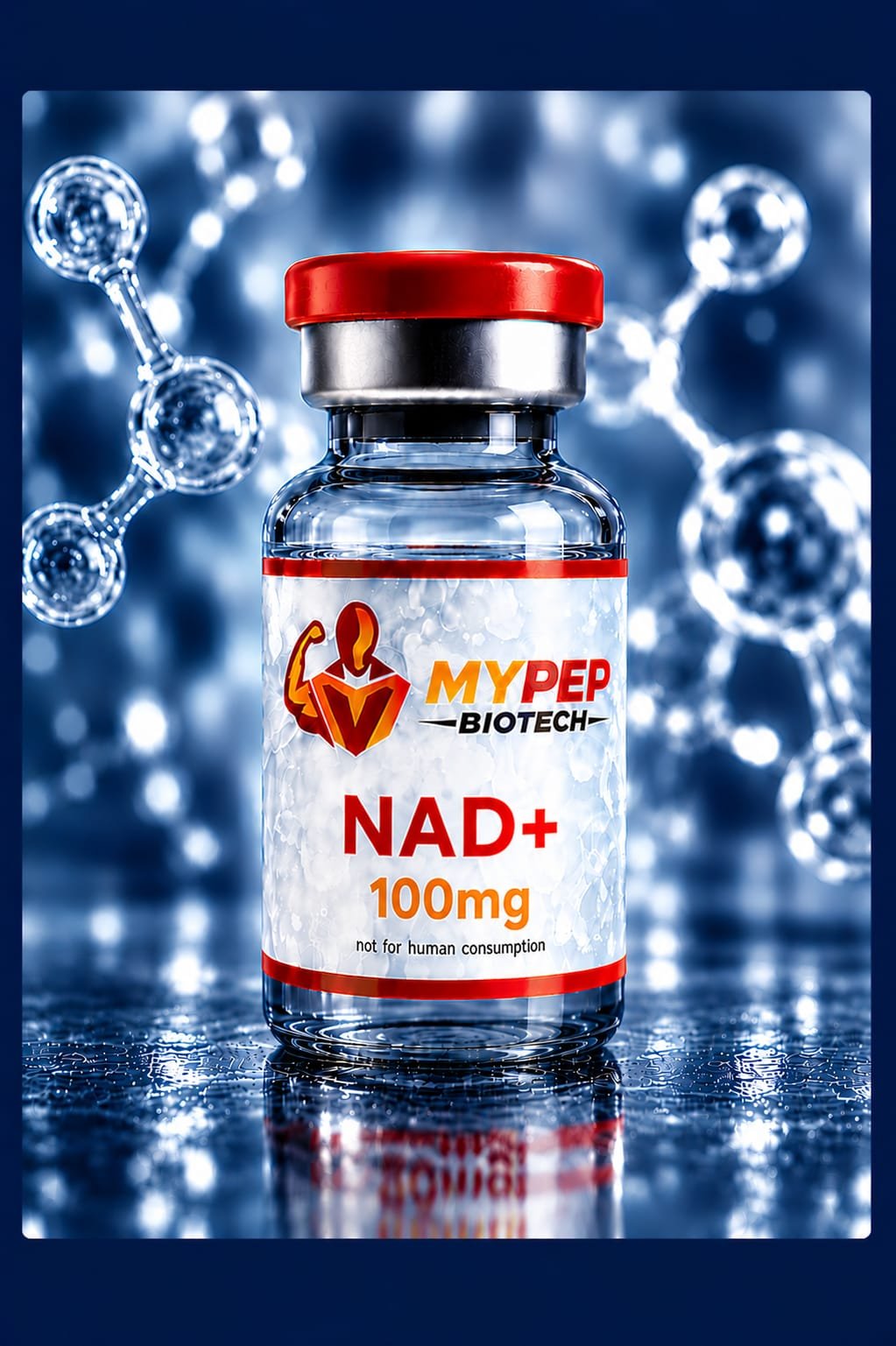
NAD+ 1000mg research compound supplied strictly for laboratory and in-vitro research use. NAD+ is a coenzyme, not a peptide, and is not supplied for human or animal consumption, diagnosis or therapy.
Nicotinamide adenine dinucleotide is a naturally occurring redox cofactor studied in cellular metabolism, mitochondrial function and enzyme-regulated pathways. This high-strength research format is intended for controlled laboratory work requiring traceable material and batch documentation.
- 1000mg research format
- UK-held stock with tracked dispatch
- Batch Certificate of Analysis available
- Clearly labelled for research use only
NAD+ 1000mg research context
NAD+ participates in electron-transfer reactions that support cellular metabolism. It also acts as a substrate for enzyme families including sirtuins, poly-ADP-ribose polymerases and CD38-related pathways. Researchers study these mechanisms in defined biochemical assays, cell systems and preclinical models.
An observed change in a laboratory marker does not establish a therapeutic outcome. Conclusions should remain limited to the tested model, concentration, exposure period and analytical endpoint.
Compound identity and quality records
As a dinucleotide coenzyme, NAD+ should not be described or evaluated as though it were a peptide sequence. Analytical documentation should identify the material, batch, method and reported result. High-performance liquid chromatography can separate sample components and support compositional assessment, while complementary methods may be used for identity confirmation.
A purity percentage does not demonstrate sterility, biological activity or clinical suitability. Review the HPLC purity guide and Certificate of Analysis guide for general documentation principles.
Experimental design considerations
- Use controls appropriate to the assay and solvent system.
- Record the exact lot, preparation date and storage conditions.
- Predefine primary endpoints and analysis methods.
- Consider degradation and oxidation when interpreting results.
- Report uncertainty, exclusions and model limitations.
NAD-related measurements can be sensitive to sample processing and analytical technique. Researchers should use validated methods and avoid comparing results generated through incompatible assays without appropriate qualification.
Storage, handling and traceability
Follow the batch documentation and institutional standard operating procedures. Protect the material from unsuitable temperature, moisture and light, and keep the container securely labelled. Maintain a traceable link between the vial, Certificate of Analysis and raw experimental records.
The research compound handling guide and storage guide provide general laboratory considerations; compound-specific instructions always take priority.
Reviewing NAD+ evidence
Search primary literature using the compound name, enzyme or pathway, experimental model and outcome. Resources such as PubMed can help locate original studies, reviews and corrections.
NAD+ 1000mg is supplied solely as a laboratory research material. Researchers are responsible for confirming that purchase, handling and experimental use comply with applicable law, institutional policy and ethical requirements.
Suggested research records
For reproducibility, document the supplier, product name, lot number, analytical certificate, storage history and exact preparation method. Record instrument settings, calibration materials and extraction procedures used for NAD-related measurements. Where several metabolites are analysed together, define how peak identity and quantification were established.
Include raw values and quality-control results rather than reporting only normalised changes. If samples are collected across time, use consistent processing intervals and account for degradation during collection and storage. A clear audit trail makes it easier for another laboratory to repeat the work and assess whether an apparent difference reflects biology or sample handling.
Interpreting metabolic measurements
NAD+, NADH and related metabolites form interconnected pools. A change in one measurement may reflect altered production, consumption, compartmentalisation or analytical recovery. Interpret ratios and pathway markers alongside appropriate controls instead of treating one value as a complete measure of cellular energy or ageing.
NAD+ 1000mg method validation and data quality
Before interpreting an experiment, verify assay sensitivity, specificity, working range and quality controls. Record instrument settings, calibration status, reagent lots and acceptance criteria. If a quality-control condition falls outside the approved range, repeat the measurement according to the laboratory protocol instead of selecting a different processing method after seeing the result.
Cross-study comparisons should account for differences in material identity, preparation, model system, sampling schedule and endpoint definition. Report limitations including small sample sizes, surrogate endpoints, missing observations and uncertainty about stability. Retain raw files, calculation formulas, data transformations and software versions to support independent replication.
Transparent analytical reporting
State the assay principle, sample preparation, detection method, normalisation approach and all quality-control results. Report both successful and failed runs according to the pre-defined protocol. Where possible, provide individual observations and uncertainty intervals rather than only summary values.
Document storage history and freeze-thaw exposure whenever these factors could influence material integrity. Any deviation from the original study plan should be dated, explained and retained with the final laboratory record.
How should NAD+ 1000mg be documented?
NAD+ 1000mg records should include the batch reference, analytical report, storage history, preparation method and assay conditions. These details allow measured results to be traced to the exact research material.
What does NAD+ 1000mg purity indicate?
NAD+ 1000mg purity describes the analytical result produced under the stated test method. It should be considered with identity, stability, handling and suitability for the selected assay.
How should NAD+ 1000mg findings be compared?
Compare NAD+ 1000mg studies only after reviewing differences in material identity, model system, sampling schedule, endpoint definition and statistical reporting.
Reviews
There are no reviews yet.