
How Long Do Lyophilised Peptides Last at Room Temperature?
A common laboratory question is how long lyophilised peptides last at room temperature. This guide covers dry-powder stability, the effect of short-term room-temperature exposure, freeze-thaw degradation and how reconstituted material differs.
Lyophilised (dry) peptide stability
In lyophilised (freeze-dried) form, most research peptides are relatively stable. Short periods at room temperature — for example during shipping — are generally well tolerated, which is why peptides can be dispatched without dry ice. For long-term storage, however, cool conditions are preferred to maximise the stability window stated on the Certificate of Analysis.
Room-temperature exposure
Brief room-temperature exposure of the sealed dry vial is usually not a concern. Prolonged exposure to heat, humidity or light can accelerate degradation, so lyophilised peptides are best returned to a fridge or freezer once received and stored dark and dry.
Freeze-thaw and reconstituted material
Repeated freeze-thaw cycles can degrade peptides, so aliquoting before freezing is common practice. Once reconstituted, a peptide is in solution and less stable than the dry powder; it should be refrigerated and used within the timeframe appropriate to that compound.
Frequently Asked Questions
How long do lyophilized peptides last at room temperature?
Lyophilised peptides are generally stable for short periods at room temperature, such as during shipping. For long-term storage they should be kept cool, dark and dry, following the stability window on the batch Certificate of Analysis.
Do peptides need to be refrigerated?
Lyophilised peptides tolerate short room-temperature periods but are best refrigerated or frozen for long-term storage. Reconstituted peptide solutions should always be refrigerated and protected from light.
Does freezing damage peptides?
Freezing itself is fine for storage, but repeated freeze-thaw cycles can degrade peptides. Aliquoting into smaller volumes before freezing helps avoid repeated thawing of the whole batch.
This article is provided for general research and educational information only. It does not constitute advice on human or animal use, dosing, or administration. All MyPep Biotech products are supplied strictly for laboratory and in-vitro research purposes and are not for human consumption.
← Back to all Research GuidesLyophilised peptides at room temperature: seven factors to document
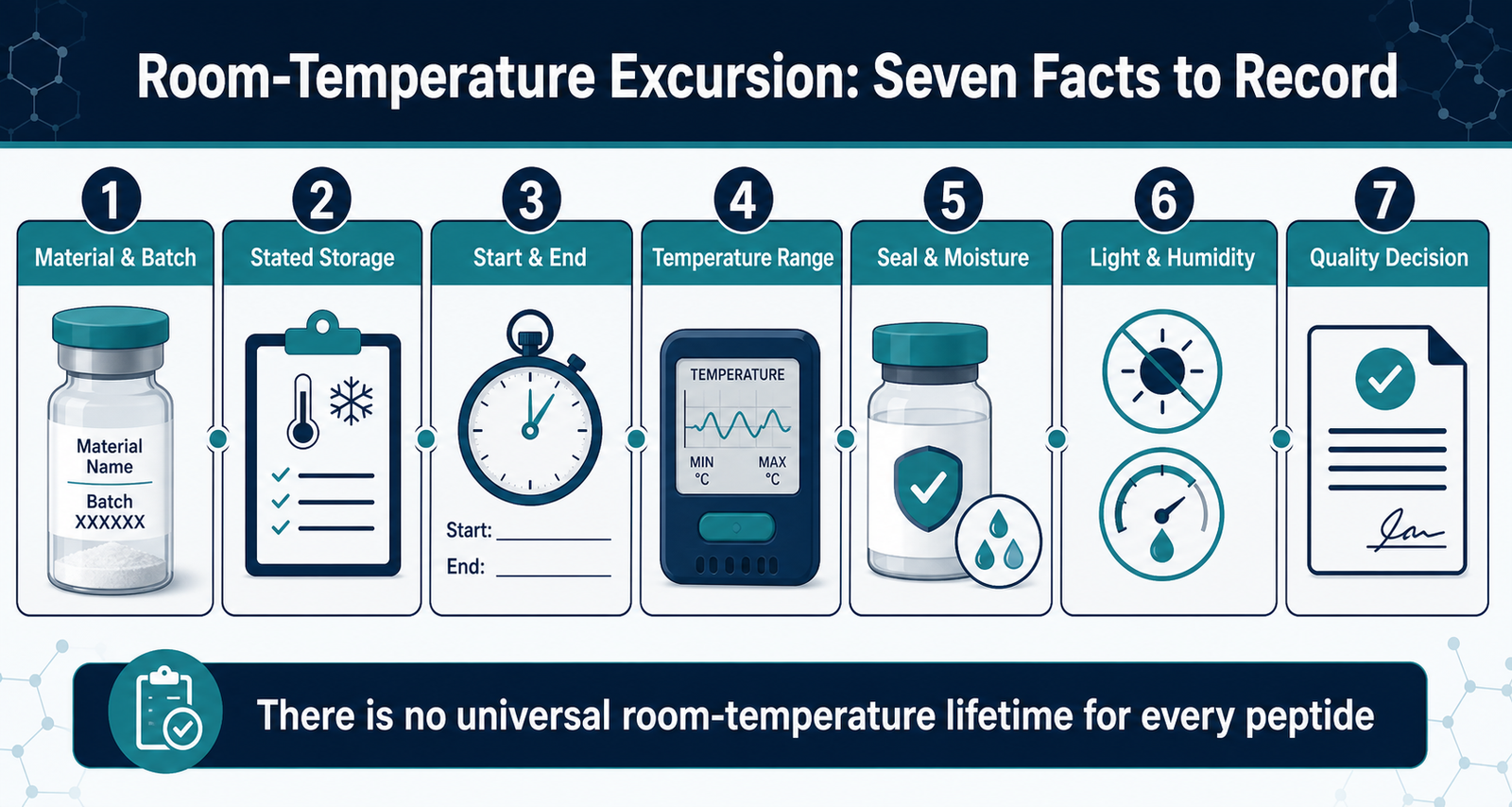
How long lyophilised peptides last at room temperature cannot be answered reliably with one universal number. Stability depends on the compound, formulation, packaging, moisture exposure, temperature profile and the evidence supporting the stated storage condition. Use batch documentation and a laboratory-approved stability assessment.
- The exact compound, form and batch.
- The manufacturer or supplier storage statement.
- The start and end time of the excursion.
- The minimum and maximum recorded temperature.
- Whether the container remained sealed and dry.
- Exposure to light, humidity or repeated cycling.
- The documented decision to retain, investigate or discard the material.
Why a temperature excursion needs context
A brief controlled transfer is different from an unknown period in warm or humid conditions. Record objective information before making a quality decision. Appearance alone cannot confirm stability.
Use the peptide storage guide to build the routine storage log and the certificate guide to retain batch evidence. The official ICH quality guidelines include stability and analytical-quality resources.
Room-temperature stability FAQ
Is every lyophilised peptide equally stable?
No. Sequence, formulation, packaging and environmental conditions can all influence stability.
Can refrigeration reverse a previous excursion?
Returning material to storage does not erase the excursion; document it and assess its impact.
Does a normal appearance prove the material is unchanged?
No. Visual inspection cannot establish molecular integrity or purity.
Research-use notice: Educational storage information for controlled laboratory research only.
Further Reading on Lyophilised Peptides Last At Room Temperature
Peer-reviewed literature relating to lyophilised peptides last at room temperature can be explored through the U.S. National Library of Medicine database, PubMed. All material on this site is provided strictly for laboratory and in-vitro research use only, and is not for human or veterinary use.
Related Storage and Handling Guides
For best-practice on keeping research peptides stable, see our peptide storage guide, reconstitution guide, and compound handling guide. Bacteriostatic water for reconstitution is available in the catalogue. All materials are supplied strictly for laboratory and in-vitro research use only, and are not for human or veterinary use.