
Description
Educational information only. This guide discusses how to assess peptide research and is not medical advice. Products referenced by MyPep Biotech are supplied strictly for laboratory and in-vitro research use.
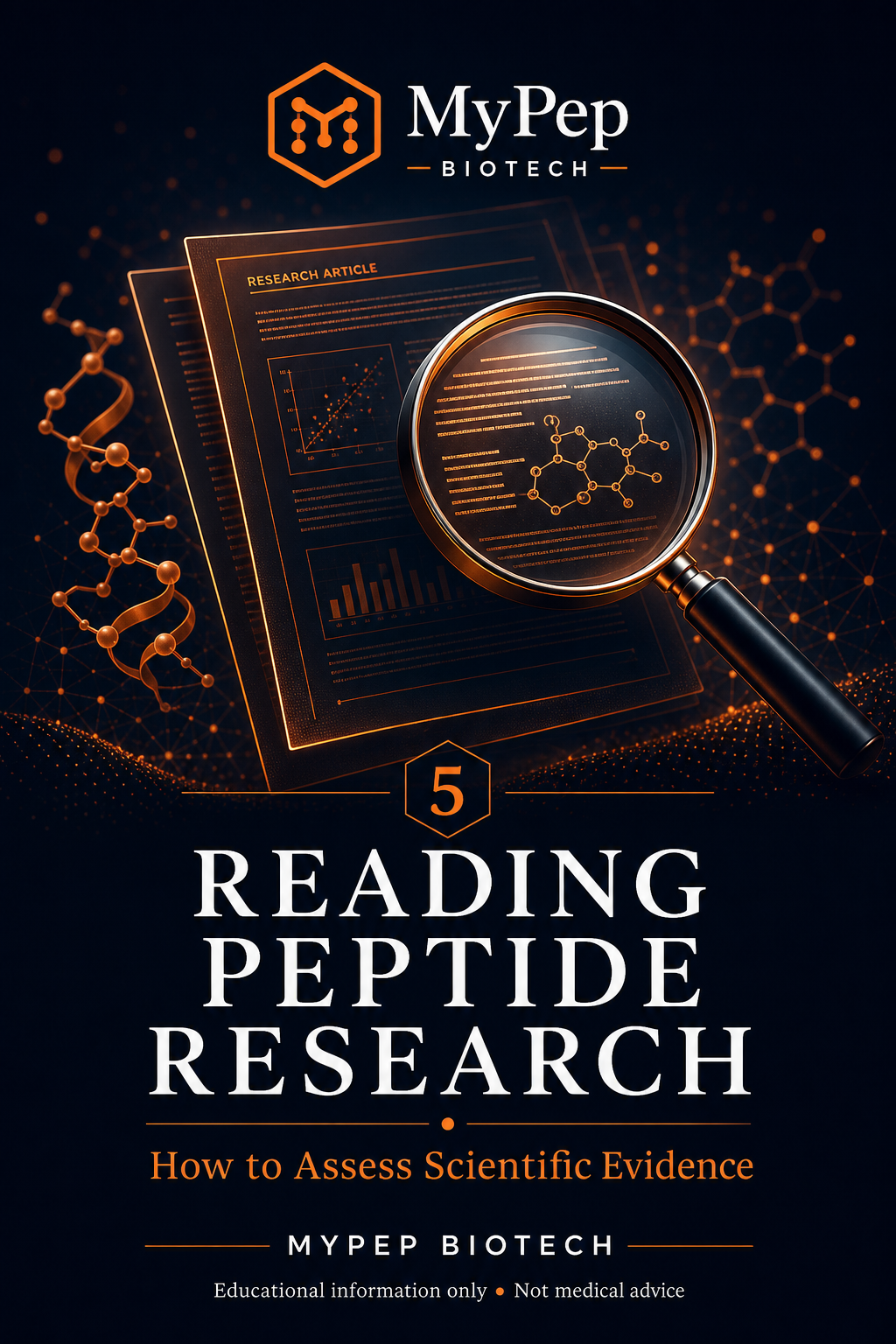
Peptide research covers a wide range of laboratory disciplines, from cell signalling and receptor activity to analytical chemistry and molecular stability. Because the field develops quickly, researchers need a consistent way to separate useful evidence from promotional claims. This guide introduces a practical framework for reading peptide studies, checking methods and deciding how much confidence to place in a result.
What counts as reliable peptide research?
Reliable peptide research begins with a clearly defined question, a suitable experimental model and methods that another laboratory could reproduce. A paper should identify the compound, sequence or analogue being studied, explain how it was prepared and describe the concentration, controls and observation period. Results are more useful when authors report uncertainty, limitations and all relevant outcomes rather than only favourable findings.
The publication venue alone does not guarantee quality. Peer review is valuable, but readers should still examine the experimental design, sample size, statistical analysis and whether the conclusions match the data. A single experiment can generate a hypothesis; repeated findings from independent groups provide stronger support.
Check compound identity and analytical evidence
For laboratory work, the identity and purity of the material are fundamental. Researchers should look for batch-specific documentation such as high-performance liquid chromatography data and, where appropriate, mass-spectrometry confirmation. An HPLC purity percentage describes the chromatographic composition of a sample; it does not by itself demonstrate biological activity, sterility or suitability for any clinical purpose.
Our guide to HPLC purity explains how chromatograms are interpreted, while the Certificate of Analysis guide covers lot numbers, test dates and common documentation fields. When sourcing a material, match the batch number on the vial to the analytical record rather than relying on a generic example certificate.
Evaluate the study design
Start by identifying whether the study is in-vitro, animal-based, observational or interventional. These designs answer different questions and should not be treated as interchangeable. An effect observed in a cell culture does not establish the same outcome in a complex organism. Likewise, results from one species, dose range or administration method may not transfer to another context.
- Controls: Was the experimental condition compared with an appropriate negative or vehicle control?
- Replication: Were measurements repeated within the experiment, and has another group reproduced the finding?
- Blinding: Could knowledge of the group allocation influence measurement or interpretation?
- Sample size: Was the study large enough to detect the proposed effect?
- Outcome selection: Were the primary outcomes defined before the results were known?
Read beyond the abstract
Abstracts are useful summaries, but they omit important details. Read the methods and results sections before accepting the headline conclusion. Check whether graphs show individual observations, whether excluded data are explained and whether relative changes are accompanied by absolute values. Statistical significance does not automatically mean that an effect is large, reliable or practically important.
Also review conflicts of interest and funding statements. Commercial funding does not invalidate a study, but it is relevant context. Compare the claims in the discussion with the measurements actually reported.
Use primary and traceable sources
Prefer the original research paper over summaries, social posts or copied product descriptions. Databases such as PubMed help researchers locate biomedical literature, while DOI records provide a persistent route to the published work. Reviews can explain the broader field, but their conclusions should be checked against the cited primary studies.
Search systematically using the peptide name, relevant receptor or pathway, experimental model and outcome. Record the search date and selection criteria so the process can be repeated. Pay attention to retractions, corrections and updated versions.
Recognise common warning signs
Be cautious when a source makes therapeutic promises from preclinical data, omits the experimental model, uses phrases such as “proven” without citations or presents a purity figure without batch documentation. Other warning signs include copied references that do not support the claim, selective discussion of positive results and confusion between laboratory evidence and authorised medical use.
A repeatable reading checklist
- Define the research question and the type of evidence needed.
- Confirm the compound identity, sequence and batch documentation.
- Identify the model, controls, concentration and duration.
- Review the full methods and results rather than relying on the abstract.
- Check sample size, replication, uncertainty and limitations.
- Trace major claims back to primary sources.
- Record the evidence and note where findings remain uncertain.
Good peptide research depends on careful sourcing, transparent methods and proportionate conclusions. Explore the MyPep Biotech research guides for related material on storage, handling and analytical documentation, or browse the research peptide catalogue for compounds supplied with research-use labelling.

Reviews
There are no reviews yet.