Description
Educational information only. This page discusses peptides in a research context and is not medical advice. MyPep Biotech products are supplied strictly for laboratory and in-vitro research use.
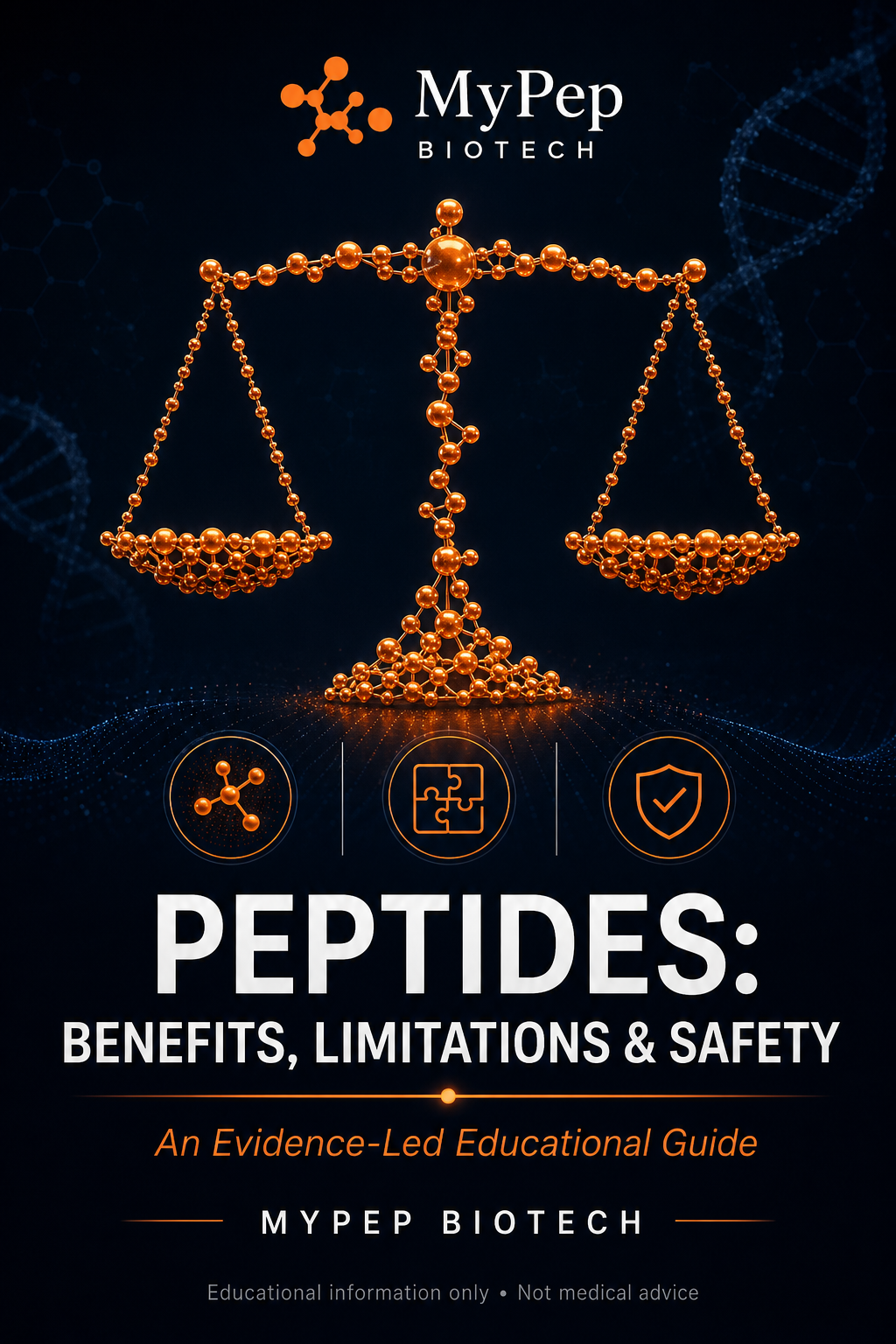
Peptides are short chains of amino acids that participate in signalling, structural and regulatory processes. Their diversity makes them useful research tools, but it also means that broad claims about “peptides” should be treated carefully. The properties of one sequence cannot automatically be applied to another. For a plain-language primer, see our guide to what peptides are.
How peptides are studied
Researchers investigate peptides using biochemical assays, cell models, analytical instruments and, where ethically appropriate, more complex experimental systems. A study may examine receptor binding, stability, transport, degradation or downstream signalling. The correct interpretation depends on the specific sequence, concentration, model and endpoint.
Reliable work starts with confirmed compound identity. Batch documentation may include high-performance liquid chromatography and mass-spectrometry data. Our HPLC purity guide explains what chromatographic purity can and cannot demonstrate.
Potential benefits of peptides as research tools
- Defined molecular targets: Some sequences interact with particular receptors or pathways, allowing focused laboratory questions.
- Sequence flexibility: Researchers can compare native sequences with modified analogues to study structure and function.
- Measurable activity: Binding, enzyme activity and signalling responses can often be quantified under controlled conditions.
- Model development: Peptides can help researchers probe biological mechanisms before broader hypotheses are tested.
These advantages describe experimental utility. They do not establish safety, efficacy or suitability for personal use.
Important limitations
Peptides can be sensitive to heat, light, oxidation and repeated freeze-thaw cycles. Stability differs between sequences and formulations, so storage instructions should be based on compound-specific evidence. Review our peptide storage guide for general laboratory considerations.
Results may also be model-dependent. An observation in a purified enzyme assay may not occur in a cell, and a cell-culture result may not translate to an organism. Dose, exposure time, solvent and control selection can substantially change an outcome.
Purity is another frequent source of misunderstanding. A 99% chromatographic purity result does not prove identity without complementary analysis, and it does not demonstrate sterility, biological activity or clinical suitability.
Safety and responsible interpretation
Research materials should be handled under an appropriate institutional risk assessment using suitable protective equipment, containment and disposal procedures. Labels and batch records should remain linked to the sample throughout the study. Researchers must comply with applicable laws, ethics requirements and laboratory policies.
Claims should remain proportionate to the evidence. Avoid treating preclinical observations as medical conclusions, and distinguish clearly between an experimental mechanism and an approved therapeutic use.
How to evaluate peptide evidence
- Confirm the exact sequence, analogue and batch.
- Check the analytical method and supporting documentation.
- Identify the experimental model, controls and concentration.
- Read the full methods and results, not only the abstract.
- Look for replication, uncertainty and stated limitations.
- Trace important claims to primary literature through resources such as PubMed.
Used carefully, peptides can support precise and reproducible laboratory questions. Browse the research guide library for further material on documentation, storage and handling, or view the research peptide catalogue.

Reviews
There are no reviews yet.