Bacteriostatic Water: A Research Guide
Bacteriostatic water — often shortened to “bac water” — is the diluent most commonly referenced for reconstituting lyophilised research peptides. This guide explains what it is, how it differs from sterile water, and how it is handled in the laboratory.
What is bacteriostatic water?
Bacteriostatic water is water for injection that contains a small amount of benzyl alcohol (typically 0.9%) as a bacteriostatic agent. The benzyl alcohol limits the growth of bacteria, which is why bac water is preferred for multi-use vials that will be accessed more than once.
Bacteriostatic water vs sterile water
Sterile water contains no preservative, so once a sterile-water vial is opened it is generally intended for single use. Bacteriostatic water’s preservative allows a reconstituted peptide solution to be drawn from repeatedly over a longer period while limiting microbial growth.
Using bac water to reconstitute peptides
To reconstitute, the diluent is added slowly down the inside wall of the vial rather than directly onto the peptide pellet, then left to dissolve without vigorous shaking. Our peptide calculator turns the vial contents and water volume into a working concentration.
Bacteriostatic water for peptide research
In peptide research, bacteriostatic water (bac water for peptides) is the standard diluent because its benzyl alcohol content limits microbial growth in a vial that will be accessed repeatedly over several days. This makes bacteriostatic water for peptides UK laboratories a practical choice for reconstituting multi-use vials, compared with preservative-free sterile water that is generally intended for single use. The same product is often referenced in other contexts, such as hcg bacteriostatic water, but its function as a preserved diluent is identical.
Where to buy bacteriostatic water
Researchers deciding where to buy bacteriostatic water (or where to buy bac water) should choose a supplier that provides clearly labelled, correctly sealed vials suitable for laboratory reconstitution work. When you buy bacteriostatic water for research, look for the same standards you would expect of any laboratory consumable: clear labelling, intact seals and appropriate storage. MyPep Biotech supplies bacteriostatic water UK-side alongside research peptides so that a reconstitution workflow can be sourced together, dispatched same-day for laboratory research use only.
Storage and handling of bac water
Store bacteriostatic water cool and dark, keep the vial sealed until use, and observe the expiry and in-use period indicated on the label. Once a peptide is reconstituted in bac water online-sourced or otherwise, the resulting solution is less stable than the dry powder and should be refrigerated, protected from light and used within the timeframe appropriate to that compound. Good handling of both the diluent and the reconstituted solution protects the investment made in high-purity research material.
Research compound handling guide →
Bacteriostatic water storage and equipment
Both bacteriostatic water and any reconstituted solution benefit from consistent cool storage. A small dedicated peptides fridge keeps 10ml bacteriostatic water vials and reconstituted solutions at a stable refrigerated temperature, while an insulated peptides cooler or peptide storage case protects vials from temperature swings during transport. Whats bac water sensitive to is heat, light and repeated warming and cooling, so keeping the diluent in a dark, temperature-controlled container preserves both the diluent and the high-purity peptide it is used to reconstitute. Commonly stocked formats include 10ml bacteriostatic water; whichever size you buy bac water in, store it sealed and labelled until needed.
Frequently Asked Questions
Where can I buy bacteriostatic water in the UK?
You can buy bacteriostatic water from research suppliers that stock laboratory consumables, including MyPep Biotech, which supplies bac water UK-side alongside research peptides for laboratory research use only. Choose clearly labelled, correctly sealed vials.
What is bacteriostatic water used for?
In research, bacteriostatic water is used as a diluent to reconstitute lyophilised peptides. Its benzyl alcohol content limits bacterial growth, making it suitable for multi-use vials accessed over several days.
How long does reconstituted peptide last in bacteriostatic water?
Reconstituted peptides are generally less stable than the lyophilised powder and should be refrigerated and protected from light. Stability varies by compound; consult the batch Certificate of Analysis and our storage guide for handling references.
Is bac water the same as bacteriostatic water?
Yes. “Bac water” is simply a common shorthand for bacteriostatic water.
This article is provided for general research and educational information only. It does not constitute advice on human or animal use, dosing, or administration. All MyPep Biotech products are supplied strictly for laboratory and in-vitro research purposes and are not for human consumption.
← Back to all Research GuidesLooking for bacteriostatic water and other essentials to support your research? Browse our Laboratory Essentials category.
Bacteriostatic water research: documentation and quality checks
Bacteriostatic water should be assessed as a laboratory material with a documented identity, source, lot number and storage history. A label alone does not establish suitability for a particular protocol. The responsible laboratory should approve the material specification and record why it is appropriate for the intended in-vitro procedure.
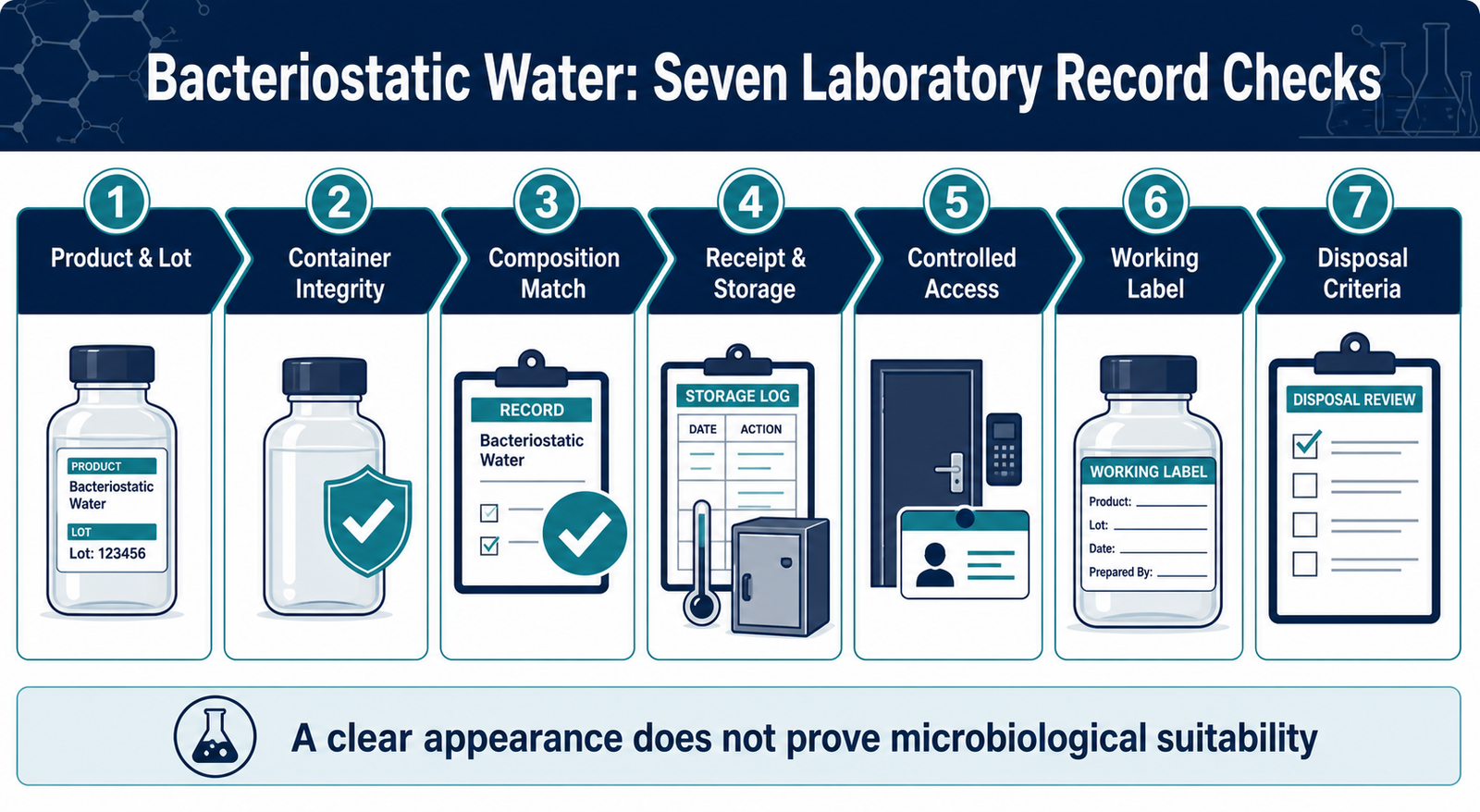
Seven checks for the laboratory record
- Record the manufacturer or supplier, lot number and expiry or retest information shown on the container.
- Inspect the closure and container before first access, noting damage, leakage or visible particulate matter.
- Confirm that the product description and composition match the written laboratory procedure.
- Document receipt and storage conditions, including any temperature excursion.
- Use a controlled aseptic workflow suitable for the laboratory and avoid repeated uncontrolled access.
- Label any working preparation with an unambiguous identifier, preparation date and responsible operator.
- Define disposal criteria in the laboratory procedure rather than relying on appearance alone.
Contamination control and traceability
The term bacteriostatic describes inhibition of bacterial growth; it should not be interpreted as a guarantee that poor handling cannot introduce contamination. Laboratories should apply their own approved aseptic controls, equipment-cleaning procedures and environmental requirements. The research compound handling guide provides a broader documentation checklist.
Analytical and quality procedures should be fit for their intended purpose. The official ICH quality guidelines provide a useful framework for analytical method development and validation, while UKAS laboratory-accreditation resources explain competence and traceability expectations.
Bacteriostatic water FAQ
Does bacteriostatic water remain suitable indefinitely after opening?
No universal period should be assumed. Suitability depends on the product information, access conditions and the laboratory’s validated procedure.
Is a clear appearance proof that contamination is absent?
No. Visual inspection can identify some obvious problems but cannot establish microbiological suitability.
What should be recorded?
Record the lot, source, receipt date, storage, first-access date, operator and the project or preparation in which the material was used.
Research-use notice: Educational information for controlled laboratory and in-vitro research only; it is not administration or dosing guidance.