Peptide Reconstitution Calculator: Step-by-Step Guide
Reconstituting a lyophilised peptide accurately is one of the most important steps in preparing it for research. This guide explains the maths behind reconstitution and shows how to use our free peptide reconstitution calculator.
The reconstitution formula
Concentration equals the mass of peptide divided by the volume of diluent added. If you dissolve 5 mg of peptide in 2 ml of bacteriostatic water, the concentration is 5 ÷ 2 = 2.5 mg/ml, or 2500 mcg/ml. To find the volume containing a target amount, divide that amount by the concentration.
Worked example
Suppose a vial contains 10 mg of peptide and you add 2 ml of bacteriostatic water. Concentration = 10 ÷ 2 = 5 mg/ml (5000 mcg/ml). A 250 mcg research draw would be 250 ÷ 5000 = 0.05 ml, which equals 5 units on a U-100 insulin syringe.
Open the peptide reconstitution calculator →
Choosing a diluent volume
Adding more diluent gives a lower concentration and larger, easier-to-measure draw volumes; less diluent gives a higher concentration. Researchers usually pick a volume that makes their target draws land on convenient syringe markings.
How to reconstitute peptides: step by step
Learning how to reconstitute peptides accurately is a core laboratory skill. As a general reference: (1) allow the lyophilised vial and the bacteriostatic water to reach room temperature; (2) clean both vial tops with an alcohol swab; (3) draw the chosen volume of bacteriostatic water and add it slowly down the inside wall of the peptide vial rather than directly onto the pellet; (4) leave the vial to dissolve on its own, swirling gently if needed but never shaking vigorously, since agitation can stress the peptide; (5) once fully clear, label the vial with the compound, concentration and date, and refrigerate. Use our calculator to convert the peptide mass and water volume into a working concentration before you begin. This is a preparation reference only and does not provide administration or dosing information.
Open the peptide reconstitution calculator →
Frequently Asked Questions
How do you reconstitute peptides?
To reconstitute a peptide, bring the vial and bacteriostatic water to room temperature, swab both vial tops, add the chosen water volume slowly down the vial wall, let it dissolve without shaking, then label and refrigerate. Use a peptide reconstitution calculator to work out the resulting concentration. This is a preparation reference only, not dosing guidance.
How does a peptide reconstitution calculator work?
It divides the peptide mass (mg) by the diluent volume (ml) to give the concentration, then divides your target amount by that concentration to give the volume to draw. Our calculator also converts the result into units on a U-100 insulin syringe.
How much bacteriostatic water should I add to a peptide?
There is no single correct volume — it depends on the concentration you want. Common research choices are 1 ml, 2 ml or 3 ml per vial. Use the calculator to see how each volume changes the resulting concentration and draw amounts.
This article is provided for general research and educational information only. It does not constitute advice on human or animal use, dosing, or administration. All MyPep Biotech products are supplied strictly for laboratory and in-vitro research purposes and are not for human consumption.
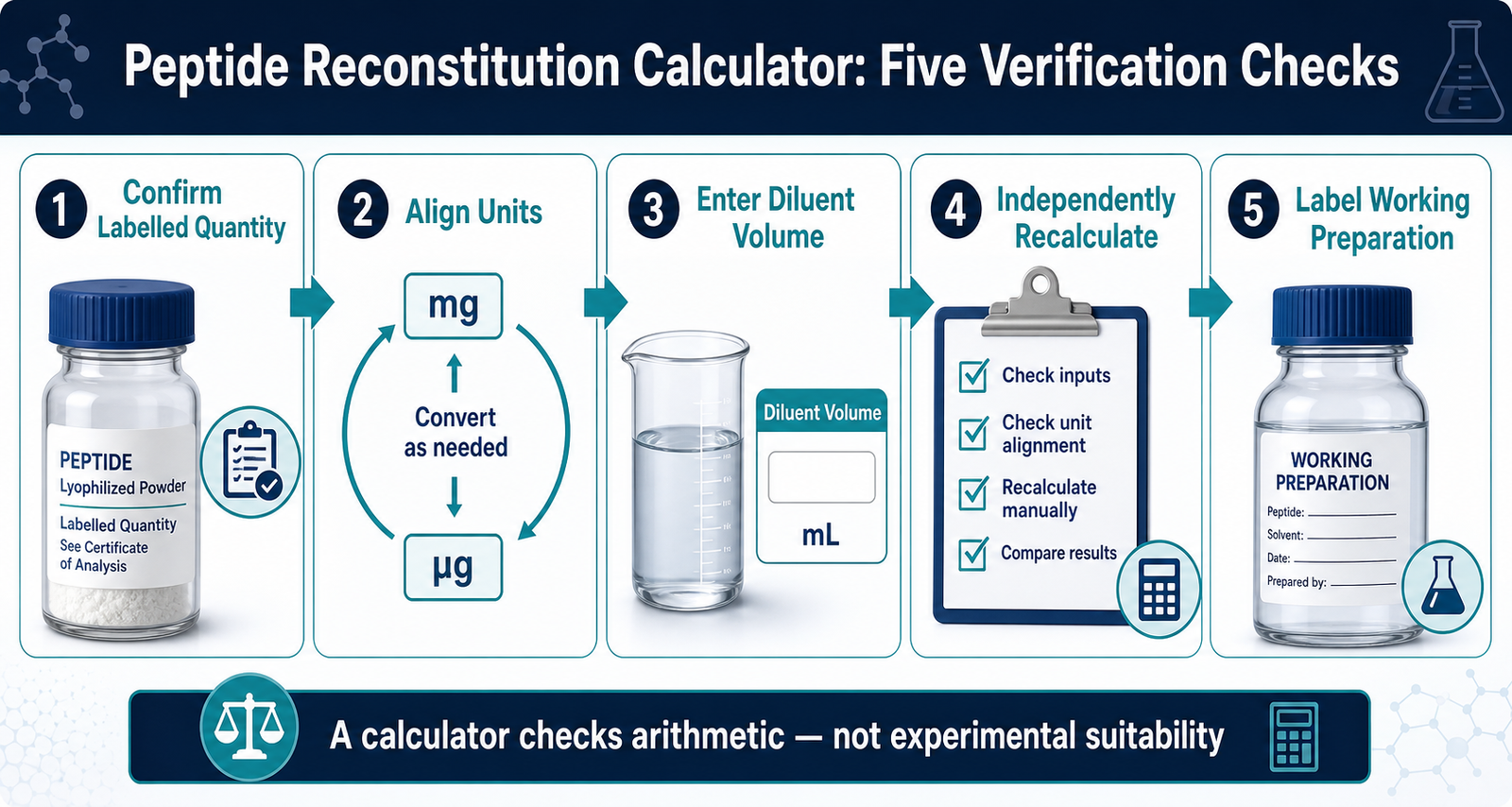
← Back to all Research GuidesPeptide reconstitution calculator: five checks before recording a result
A peptide reconstitution calculator is a mathematical reference tool. Its output is only as reliable as the values entered, the units selected and the assumptions documented. Laboratories should use an independently reviewed procedure and verify critical calculations before preparing any research solution.
- Confirm the labelled quantity and unit used as the calculation input.
- Confirm the intended final concentration and ensure units are consistent.
- Record the planned diluent volume and the equipment used to measure it.
- Check the calculation independently, including decimal placement and unit conversion.
- Label the resulting laboratory preparation with its batch link, concentration, date and operator.
Unit consistency and independent verification
Mixing milligrams, micrograms and millilitres without explicit conversion is a common source of error. Write each conversion step and retain it with the project record. The calculator result should support—not replace—technical review.
For related controls, see the peptide calculator, peptide storage guide and research compound handling guide. Analytical procedures should be suitable for their intended purpose; see the official ICH quality guidelines.
Peptide reconstitution calculator FAQ
Does the calculator validate an experimental protocol?
No. It performs arithmetic from user-supplied inputs and does not establish protocol suitability.
Why record every unit?
Explicit units make conversions reviewable and help prevent scale errors.
Should critical results be checked twice?
Use the verification requirements in the laboratory’s approved procedure; independent calculation is a sensible control for critical values.
Research-use notice: Laboratory arithmetic reference only, not human or veterinary administration guidance.