Research Peptides FAQ
This FAQ brings together the questions UK researchers ask most often about research peptides — from what peptides are to how to store and reconstitute them — with links to detailed guides for each topic.
About this FAQ
Each answer below links to a fuller guide. All information is provided for laboratory and research reference only; MyPep Biotech products are supplied strictly for in-vitro and laboratory research and are not for human consumption.
Browse the research peptide catalogue →
Frequently Asked Questions
What are peptides?
Peptides are short chains of amino acids joined by peptide bonds. In research they act as precise signalling tools studied across metabolic, tissue-repair, growth-hormone and neurological pathways. See our What Are Peptides guide for more.
Why does HPLC testing matter?
HPLC testing objectively verifies a peptide’s identity and purity. Without it there is no way to confirm a vial contains the stated compound at the stated purity, which is essential for reproducible research.
How do I store research peptides?
Store lyophilised peptides cool, dark and dry (often at -20°C for the long term) and keep reconstituted solutions refrigerated and out of light. Follow the stability window on the batch Certificate of Analysis.
How do I reconstitute a peptide?
Add a measured volume of bacteriostatic water down the vial wall and let the peptide dissolve without shaking. Our peptide calculator converts the peptide mass and water volume into a working concentration.
What is a Certificate of Analysis?
A Certificate of Analysis is a batch-specific document showing measured purity, identity, test methods and date, linking the vial you received to verified laboratory results.
What are common research applications of peptides?
Depending on the compound, research applications include metabolic and GLP-1 pathway studies, tissue-repair models, growth-hormone secretagogue research, neurological research and cellular ageing studies.
What are the advantages of a UK peptide supplier?
A UK supplier offers shorter transit, tracked domestic dispatch and no customs delays, helping preserve peptide stability. MyPep Biotech holds UK stock and dispatches HPLC-tested peptides same-day.
Are research peptides for human use?
No. All research peptides are supplied strictly for laboratory and in-vitro research and are not for human consumption, medical use or administration.
This article is provided for general research and educational information only. It does not constitute advice on human or animal use, dosing, or administration. All MyPep Biotech products are supplied strictly for laboratory and in-vitro research purposes and are not for human consumption.
← Back to all Research GuidesResearch peptides FAQ: twelve practical quality answers
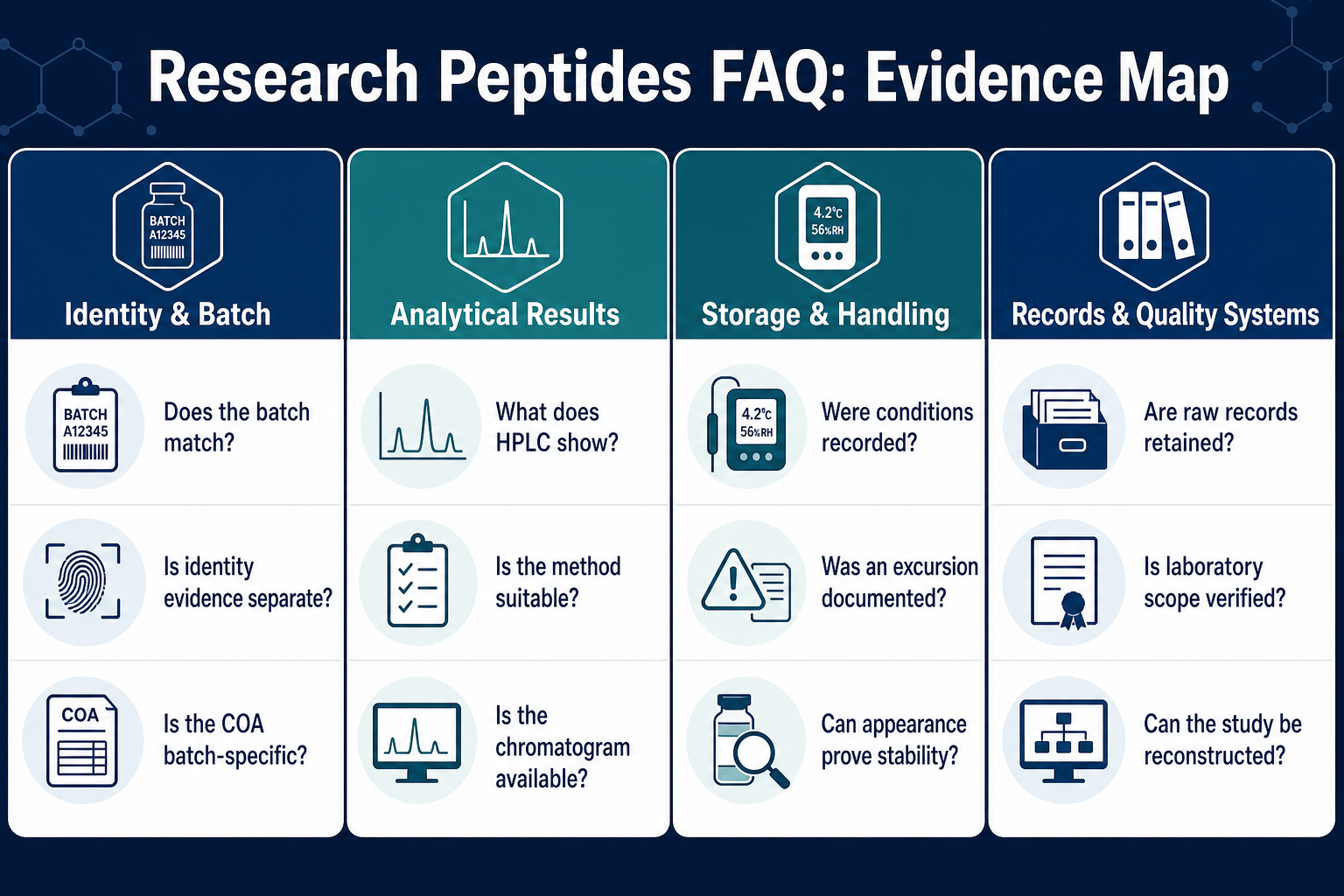
1. What should be checked when a batch arrives?
Record the supplier, product, batch, receipt date, packaging condition and assigned storage location.
2. What does HPLC purity mean?
It is a chromatographic result produced under defined method conditions; it is not automatically proof of identity or absolute vial content.
3. Should the COA batch match the vial?
Yes. An exact batch match is fundamental to document traceability.
4. Is a generic COA enough?
A batch-specific report provides stronger evidence than a generic, undated document.
5. Why retain chromatograms?
They provide context for separation, peak shape and integration that a headline percentage cannot show.
6. Does UK stock prove quality?
No. Domestic stock may shorten transit, but testing, traceability and controlled storage still need evidence.
7. How should storage be documented?
Record the required condition, actual location, monitoring and any excursion or transfer.
8. Can appearance confirm purity?
No. Visual inspection can identify some obvious defects but cannot establish analytical purity.
9. What makes an analytical method credible?
It should be suitable for its intended purpose, controlled and supported by appropriate performance evidence.
10. Why use working-preparation identifiers?
They connect each preparation and result back to the original material and batch.
11. Which records should be retained?
Retain the order, label, COA, receipt check, storage log, preparation record and relevant analytical results.
12. Where can researchers learn more?
Read the UK sourcing guide, HPLC purity guide, storage guide and official ICH quality guidelines.
Research-use notice: These research peptides FAQ answers concern controlled laboratory and in-vitro research only and do not provide human-use guidance.