Research Compound Handling: Best-Practice Guide
Careful handling protects both the integrity of research material and the reliability of results. This guide sets out general best practices for preparing, using and documenting research peptides in the laboratory.
Preparation and workspace
Work on a clean surface with the equipment you need to hand: the vial, diluent, appropriate syringes and record sheet. Reconstitute gently, adding diluent down the vial wall rather than directly onto the pellet, and avoid vigorous shaking that can stress the peptide.
Peptide calculator for concentrations →
Contamination control
Use appropriate technique to keep multi-use vials clean, and prefer bacteriostatic water for material that will be accessed more than once. Label reconstituted vials with the compound, concentration and date.
Documentation and storage
Record batch numbers, reconstitution dates and storage conditions, and keep the Certificate of Analysis on file. Store material according to its stability window — cool, dark and dry for lyophilised powder, refrigerated for reconstituted solutions.
Laboratory equipment
A basic reconstitution and handling workflow relies on a small set of laboratory consumables: the sealed peptide vial, a suitable diluent such as bacteriostatic water, graduated syringes and needles for transferring and measuring the diluent, alcohol swabs for vial-top cleaning and a record sheet. Peptide needles and syringes are referenced here only as general laboratory measuring and transfer equipment; this guide does not provide administration or dosing information of any kind. Choose graduations appropriate to the small volumes typically handled in peptide research so that measured draws are accurate.
Peptide forms and preparations
Research peptides are prepared and supplied in several forms. The most common is lyophilised peptide powder sealed in a peptide vial, reconstituted with a diluent before use. Some compounds are referenced in oral research forms such as peptide capsules or peptides tablets, while a pre-mixed peptide pen or peptide pen kit refers to material already reconstituted and packaged for measured transfer. These formats are described here only for general educational context; this guide does not provide administration or dosing information. Whichever form a laboratory works with, the same principles apply: verify purity via the Certificate of Analysis, keep sealed until needed, store within the stability window, and document the batch number.
Peptide blends and mixing
Some research protocols reference a peptide blend — more than one peptide reconstituted together or prepared alongside each other, for example combinations studied within the growth-hormone secretagogue class. When preparing any blend, keep clear records of each compound, its batch number and concentration, and follow the same gentle reconstitution and contamination-control practices used for a single peptide. Note that not all peptides are chemically compatible in the same solution, so researchers should confirm stability references for a given combination before mixing and label the resulting vial with every component and the preparation date.
Peptide reconstitution calculator →
Frequently Asked Questions
What equipment is used to handle research peptides?
A typical laboratory workflow uses the sealed peptide vial, a diluent such as bacteriostatic water, graduated syringes and needles for measuring and transferring the diluent, alcohol swabs and a record sheet. This equipment is referenced only in a general laboratory context; no administration or dosing information is provided.
What is a peptide blend?
A peptide blend refers to more than one peptide prepared together or alongside each other in a research protocol. When preparing a blend, record each compound, batch and concentration, confirm compatibility references before mixing, and label the vial with every component and the date.
How should research peptides be handled?
Handle research peptides on a clean workspace, reconstitute gently, control contamination in multi-use vials, label everything clearly and store according to the compound’s stability window. Keep the Certificate of Analysis with your records.
What equipment is needed to prepare research peptides?
Typical preparation uses the peptide vial, a suitable diluent such as bacteriostatic water, appropriately graduated syringes and a record of batch and concentration. A peptide calculator helps convert vial contents into working concentrations.
This article is provided for general research and educational information only. It does not constitute advice on human or animal use, dosing, or administration. All MyPep Biotech products are supplied strictly for laboratory and in-vitro research purposes and are not for human consumption.
← Back to all Research GuidesResearch compound handling: a seven-stage laboratory workflow
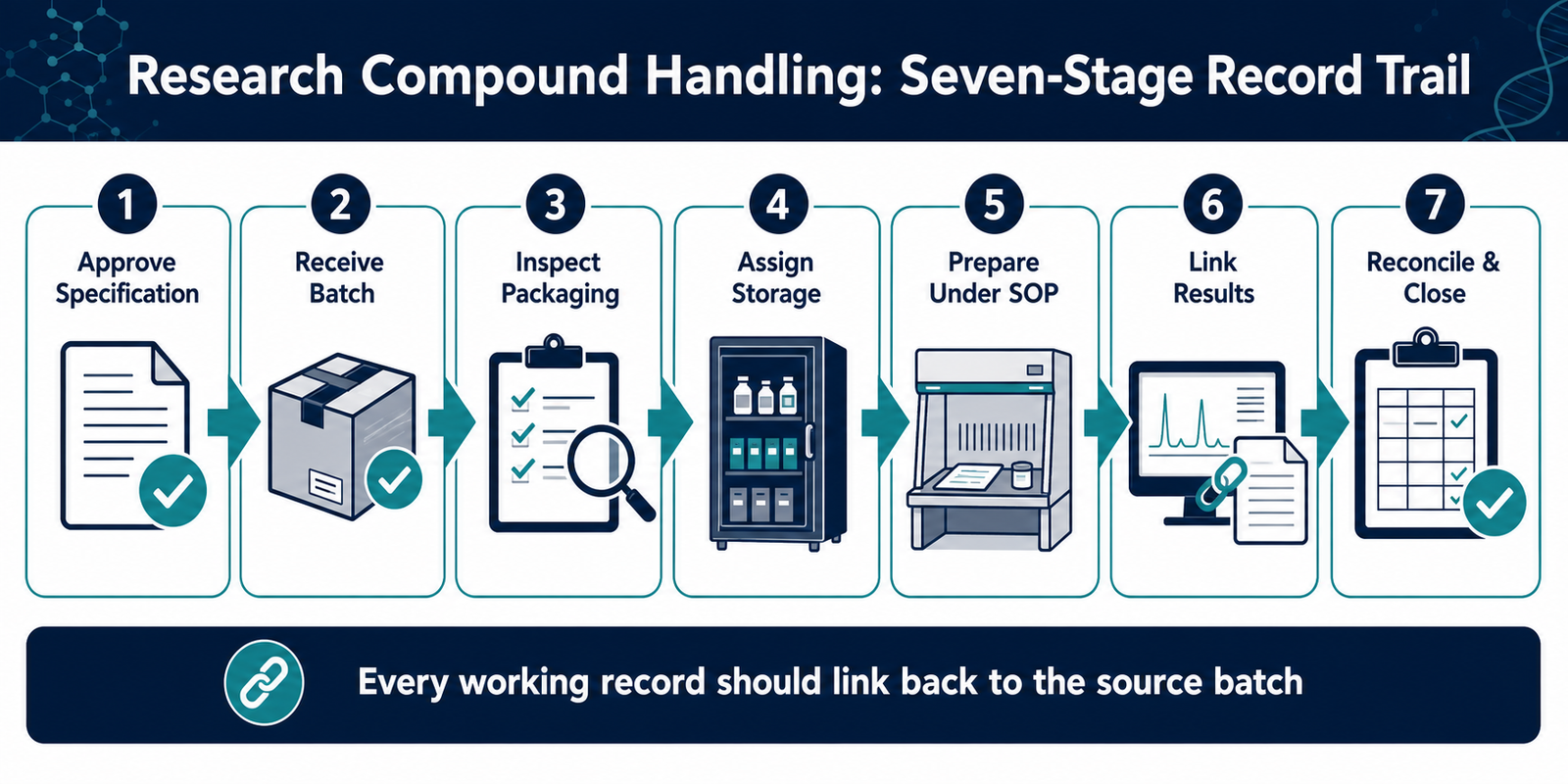
Research compound handling begins before a container is opened. A controlled workflow connects ordering, receipt, inspection, storage, preparation, analysis and disposal. Each stage should produce a clear record linked to the same batch identifier.
- Approve: define the material specification and intended in-vitro purpose.
- Receive: record supplier, batch, date and transport condition.
- Inspect: check the label, seal and packaging before acceptance.
- Store: assign a monitored location and document transfers.
- Prepare: follow a written procedure using suitable calibrated equipment.
- Use: link each working preparation and analytical result to the source batch.
- Close: reconcile remaining material and document disposal or retention.
Preventing avoidable variability
Use unambiguous labels, controlled equipment and a clean work area appropriate to the procedure. Record deviations rather than silently correcting them. The peptide storage guide covers temperature records, while the COA guide covers batch documentation.
The ICH quality guidelines provide primary guidance on analytical quality and method suitability. Laboratories can use UKAS accreditation resources when assessing competence and traceability.
Research compound handling FAQ
What is the minimum useful receiving record?
At minimum, retain the material name, supplier, batch, receipt date, condition and assigned storage location.
Why record deviations?
A deviation record allows the laboratory to assess impact and prevents unexplained changes from weakening the data trail.
Should working preparations have separate identifiers?
Yes. A working identifier should still link clearly to the original batch and preparation record.
Research-use notice: Controlled laboratory and in-vitro research information only.