HPLC Purity: How Peptide Purity Is Verified
HPLC purity is the headline quality figure for any research peptide. This guide explains how High-Performance Liquid Chromatography verifies purity, how to interpret a result, and why it matters for reproducible laboratory work.
How HPLC works
High-Performance Liquid Chromatography separates the components of a sample by pushing it through a column at high pressure. Different molecules travel at different speeds, producing a chromatogram of peaks. The target peptide appears as a dominant peak, and the area of that peak relative to the total gives the purity percentage.
Reading an HPLC purity result
A result of “99.2% purity” means 99.2% of the detected material corresponds to the target peptide, with the remainder made up of trace impurities or synthesis by-products. HPLC is often paired with mass spectrometry, which confirms the peptide’s molecular weight and therefore its identity.
Why purity matters for research
Impurities can confound an experiment by introducing effects unrelated to the target compound. High, verified purity supports reproducible, interpretable results — which is why every MyPep Biotech batch is HPLC-tested to 99%+ purity.
Frequently Asked Questions
What does HPLC purity mean?
HPLC purity is the percentage of a sample that corresponds to the target peptide, as measured by High-Performance Liquid Chromatography. A figure of 99%+ indicates that trace impurities make up less than 1% of the material.
Why is HPLC testing important for peptides?
HPLC testing objectively verifies both identity and purity, which cannot be judged by appearance. Without it, there is no way to confirm a vial contains the stated compound at the stated purity — essential for reproducible research.
This article is provided for general research and educational information only. It does not constitute advice on human or animal use, dosing, or administration. All MyPep Biotech products are supplied strictly for laboratory and in-vitro research purposes and are not for human consumption.
← Back to all Research GuidesHPLC purity: how to review a result responsibly
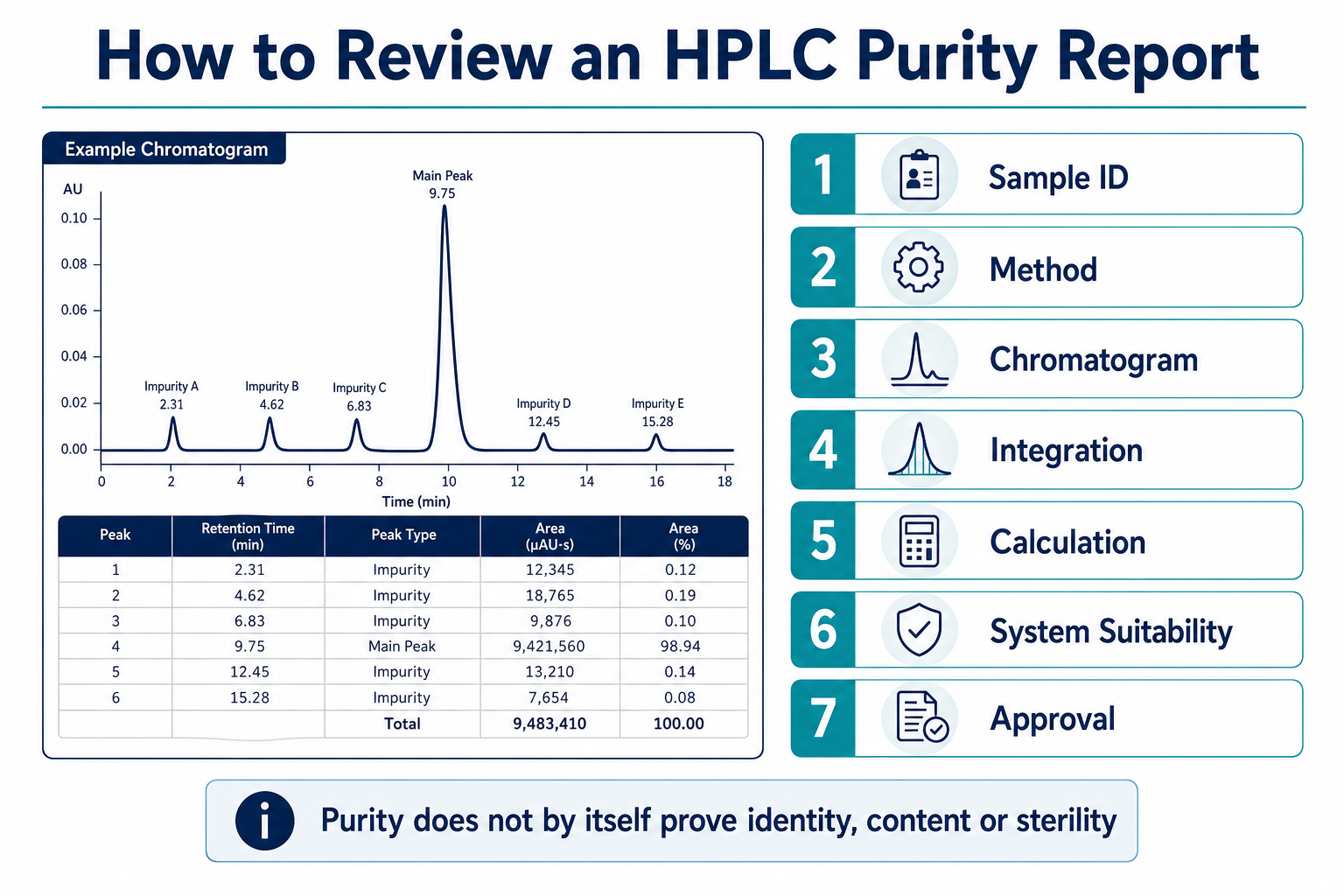
HPLC purity is a chromatographic result produced under defined analytical conditions. The percentage is meaningful only alongside the method, chromatogram, integration approach and sample identity. A responsible review asks whether the procedure was suitable for the intended measurement and whether the report can be traced to the batch received.
Seven elements to examine
- The sample and batch identifier.
- The column, mobile phase and detection conditions or a controlled method reference.
- The chromatogram and retention-time information.
- How peaks were detected and integrated.
- The calculation used for the reported purity.
- System-suitability and method-performance information.
- The analyst, laboratory, test date and report approval.
What HPLC purity does not prove alone
A high area percentage does not independently prove molecular identity, absolute content, sterility or suitability for a particular experiment. Complementary evidence may be needed according to the laboratory’s specification. The certificate of analysis guide explains how to connect multiple results to one batch.
Official ICH Q2 and Q14 quality guidance describes the principle that analytical procedures should be suitable for their intended purpose. UKAS laboratory-accreditation publications provide additional context on competence and traceability.
HPLC purity FAQ
Can results from different HPLC methods be compared directly?
Not automatically. Different columns, gradients, detectors and integration settings can produce different chromatographic profiles.
Why should the chromatogram be retained?
It provides context that a headline percentage cannot, including peak shape, separation and the basis for integration.
Is HPLC an identity test?
Retention behaviour may contribute evidence, but a laboratory should not treat purity and identity as identical analytical claims.
Research-use notice: This information concerns analytical review in controlled laboratory settings only.