
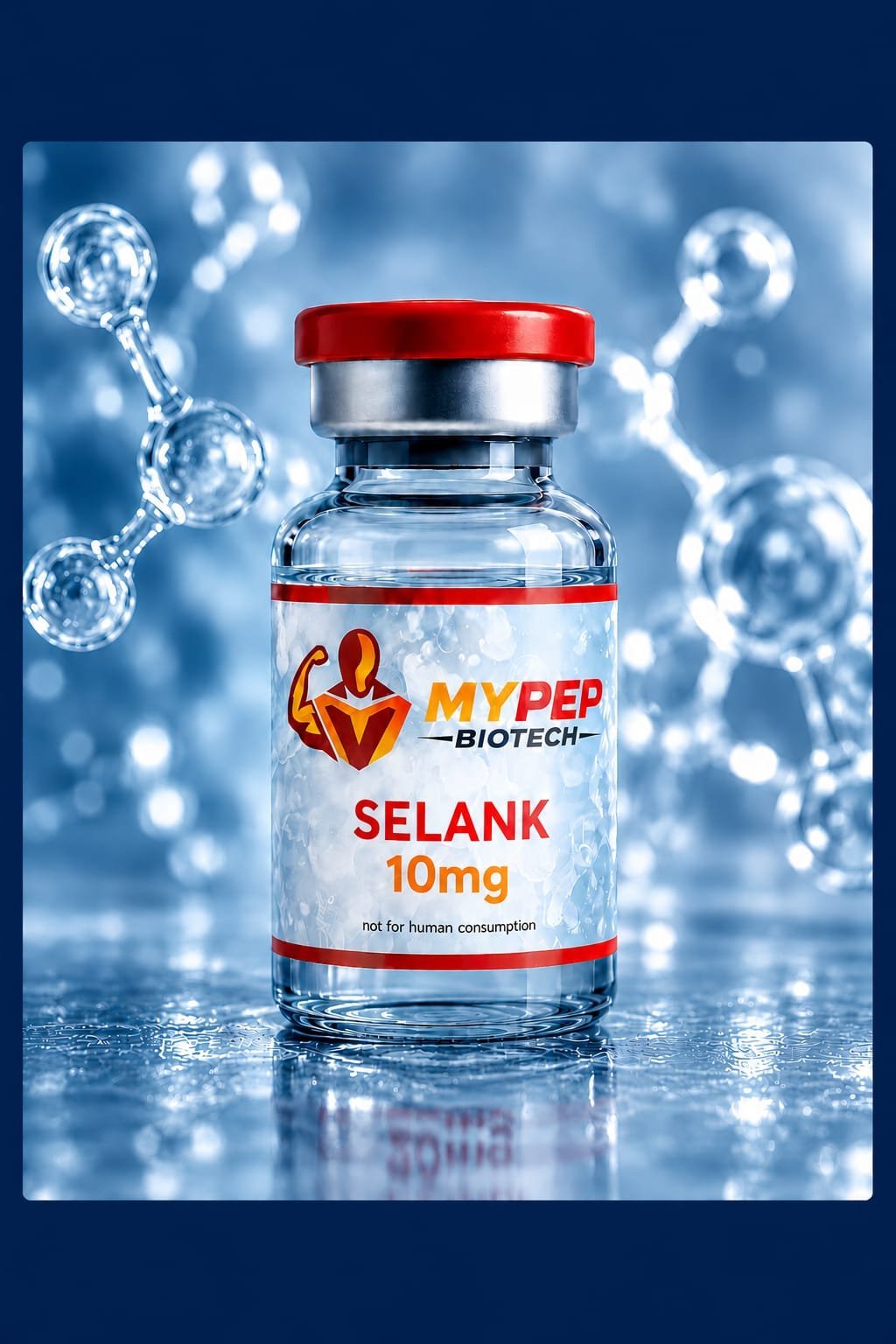
Description
Anxiolytic neuropeptide studied for calm focus, mood balance and immune modulation. Other strengths available – please get in touch via our contact page.
Buy Selank research peptide in the UK from MyPep Biotech. Every batch of Selank is HPLC-tested to 99%+ purity with a Certificate of Analysis available, held in UK stock and dispatched same-day — supplied for laboratory and in-vitro research use only.
- Genuine UK stock — dispatched from the UK
- Same-day dispatch on paid orders
- HPLC-tested for verified purity
- Secure, tracked UK delivery
Buy Selank in the UK
Researchers looking to buy Selank UK-side can order Selank online directly from MyPep Biotech, a UK-based research peptide supplier. If you are deciding where to buy Selank or looking for the best place to buy Selank for laboratory work, we hold Selank in genuine UK stock, HPLC-tested to 99%+ purity with a batch-specific Certificate of Analysis, and dispatch same-day. As an established UK peptide store and peptide company, we make it straightforward to purchase peptides UK-side with tracked delivery.
Selank is supplied strictly for laboratory and in-vitro research use only. For general context on sourcing, buying peptides UK-side and how to get peptides from a verified peptide supplier, see our research peptides UK guide. We do not provide administration or dosing information of any kind.
Helpful research resources
- Research peptides UK: sourcing & buying guide
- Bacteriostatic water guide
- Peptide storage guide
- Research compound handling guide
- Peptide reconstitution calculator
- Research peptide FAQ
Selank laboratory research overview
Selank is a synthetic peptide investigated in controlled biochemical, cellular and preclinical research models. Experimental findings depend on material identity, the selected model, concentration, exposure interval and analytical method. Observations from one model should not be presented as evidence of an outcome beyond the tested conditions.
Experimental planning checklist
- Record the Selank batch, analytical documentation and storage history.
- Define the primary endpoint and statistical plan before collecting data.
- Use vehicle, negative and relevant positive controls.
- State preparation conditions, concentration and exposure duration.
- Report replicate counts, exclusions and protocol deviations.
Analytical quality and assay suitability
Chromatographic purity contributes useful information about a batch but does not by itself establish biological activity. Identity, stability, handling, sample preparation and assay validation also affect reproducibility. Researchers should consider matrix interference, adsorption and detector suitability when interpreting measured responses.
Evidence and reporting standards
Compare studies by model, endpoint selection, sampling schedule, sample size and transparency. Present effect sizes and uncertainty intervals as well as statistical significance. Indexed literature can be searched through PubMed, and our research-reading guide explains general evidence-quality checks.
Reproducibility records
Retain the protocol, batch documents, preparation record, raw instrument files, processing steps, analysis code and final report. Use consistent sampling schedules and equipment settings across groups. Random allocation and blinded measurement can reduce avoidable bias.
Controls and data interpretation
Set sample-size assumptions, stopping rules and exclusion criteria before the experiment begins. If an expected observation is absent, examine stability, handling, assay interference and instrument performance before assigning a biological explanation. Report positive and null results with equal care and include enough methodological detail for independent replication.
Research-use notice: Selank is supplied strictly for laboratory and in-vitro research and is not intended for human or veterinary use.
Laboratory documentation checklist
Document reagent lots, software versions, calibration status and environmental conditions whenever they may affect the assay. Provide calculation formulas and describe any data transformations applied before statistical analysis. Cross-study comparisons should account for differences in models, analytical platforms, normalisation methods and sampling times.
Archive the original protocol, label information, analytical report, raw observations, deviations and final interpretation according to the laboratory quality system. Complete records allow later review and independent replication.
Method validation and cross-study comparison
Before interpreting an assay, verify that its sensitivity, specificity, working range and quality controls are appropriate for the research question. Record instrument settings and acceptance criteria, and repeat measurements when a quality-control condition falls outside the pre-defined range. Avoid choosing a processing method after viewing the outcome, because this can introduce analytical bias.
When comparing published studies, examine differences in peptide identity, purity method, storage, preparation, model system, exposure schedule and endpoint definition. A result should be treated as more reliable when methods are transparent, controls are suitable and independent groups can reproduce the observation.
Report limitations explicitly, including small sample sizes, surrogate endpoints, missing measurements and uncertainty about material stability. These details help readers distinguish preliminary observations from stronger evidence.


Reviews
There are no reviews yet.